





.png)



Certification system in Brazil
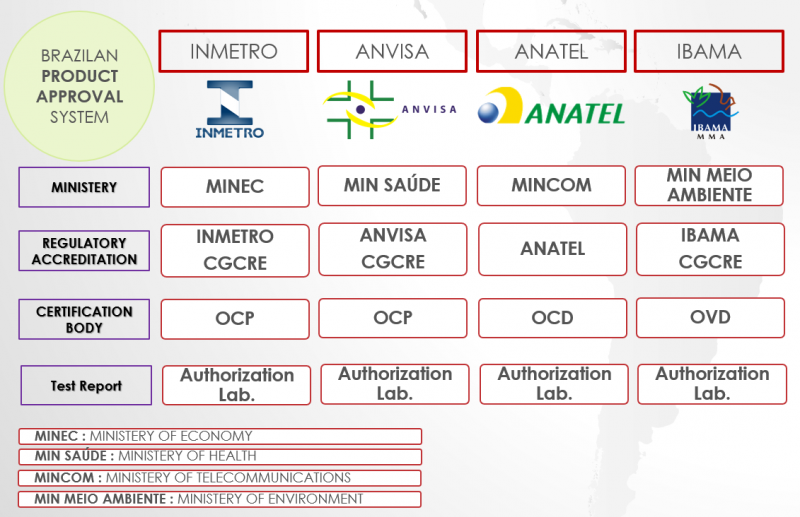
To export products to Brazil, businesses need to have their conformity assessed based on Brazil's national technical standards. Depending on the product, the methods and procedures for assessing conformity are different. The procedure for certification is very complicated and the Ordinance is constantly changing. In particular, regulations on auto parts, electronic products, and household appliances are increasingly strict. Brazil is operating mandatory certification systems such as INMETRO, ANVISA, ANATEL,
1. INMETRO Certification
To export product to Brazil, one needs to get conformity evaluation based on Brazil’s national technique standard. Depending on product, conformity evaluation method and procedure is different. Procedure to get certification is complicated and Ordinance is keep changing. Especially, regulation on parts for automobiles, electronic product, domestic appliances is becoming more strict. Brazil is running enforced certification system such as INMETRO, ANVISA, ANATEL, etc.
The National Institute of Metrology, Quality and Technology (INMETRO) is Brazil's national accreditation body, responsible for the formulation of Brazilian national standards. Most Brazilian product standards are based on IEC and ISO standards.
All products that meet the Brazilian standards and other technical requirements must be marked with the mandatory INMETRO mark and the mark of an accredited third-party certification body before they can enter the Brazilian market.
According to INMETRO, the accreditation made by the General Coordination of Accreditation (Coordenação Geral de Acreditação - Cgcre) is voluntary and represents the formal recognition of the competence of a laboratory or body to carry out conformity assessment tasks, according to established requirements.
Many types of products, including electronic medical devices, household appliances, toys, automotive parts, tires and wheels, etc., need to get INMETRO certification to enter the Brazilian market.
Product certification in Brazil is divided into compulsory certification and voluntary certification.
- Mandatory certification request section: http://www.inmetro.gov.br/qualidade/rtepac/compulsorios.asp
- Volunteer activity certification section: http://www.oconsumidor.gov.br/qualidade/rtepac/voluntarios.asp
2. ANVISA (Agencia Naciona Vigilancia Sanitaria) Certification
ANVISA certification is enforced certification on product in medical field, heatlh, beuaty product, cosmetics, ect., and it is managed by ANVISA which is under Ministry of Health and Welfare of Brazil. Especially for electric medical device, INMETRO certification is needed additionally.
The body authorized to issue product certification, known as the Product Certification Body (Organismos de Certificação de Produto - OCP), must be accredited by CGCRE, based on the principles and policies applied in SBAC - Brazilian conformity assessment system.
- ANVISA : http://portal.anvisa.gov.br/wps/portal/anvisa/home
3. ANATEL Certification
ANATEL certification in Brazil is a certification for telecommunications products. All telecommunications products and accessories must be ANATEL certified in order to be legally commercialized and used in Brazil.
ANATEL falls under the Ministry of Information and Communications in relation to the Act and regulations governing it. ANATEL registration entries are divided into 3 categories and depending on the category, the method of assessing conformity will change.
ANATEL’s standard and regulated procedure require this specific certificate for telecommunications products to be issued by a Designated Certification Body (OCD) that has been created by the regulatory agency itself.
ANATEL: http://www.anatel.gov.br/Portal/exibirPortalInternet.do
- Category I includes end user products, such as mobile phones, lithium battery and chargers for cell phone, and modems.
- Category II includes products that use radio frequency (RF), such as radio broadcasting equipment, antennas, and Wi-Fi network equipment.
- Category III includes products, such as cable connectors and fiber optic cables.
4. Brazilian Institute of Environment and Renewable Natural Resources (IBAMA)
IBAMA is a federal agency under the Ministry of Environment, with the following purposes: to perform the role of environmental police; implement national environmental policy procedures related to environmental permits, environmental quality control, natural resource use licensing and environmental monitoring, supervision and control; and carry out additional activities within the Union's competence in compliance with environmental regulations.
OVD certification bodies need to be accredited by INMETRO CGCRE for Portaria 430:2012 for noise assessment of household appliances. IBAMA noise certification applies to hair dryers, blenders, vacuum cleaners and products with similar functions manufactured in or exported to Brazil.
For the certification process of noise evaluation, it is mandatory that the appliance is certified according to INMETRO Portaria 371:2009 and complies with the additional requirements mentioned in INMETRO Portaria 388:2013. DEKRA can also support with these services.
To export product to Brazil, one needs to get conformity evaluation based on Brazil’s national technique standard. Depending on product, conformity evaluation method and procedure is different. Procedure to get certification is complicated and Ordinance is keep changing. Especially, regulation on parts for automobiles, electronic product, domestic appliances is becoming more strict. Brazil is running enforced certification system such as INMETRO, ANVISA, ANATEL, etc.
The National Institute of Metrology, Quality and Technology (INMETRO) is Brazil's national accreditation body, responsible for the formulation of Brazilian national standards. Most Brazilian product standards are based on IEC and ISO standards.
All products that meet the Brazilian standards and other technical requirements must be marked with the mandatory INMETRO mark and the mark of an accredited third-party certification body before they can enter the Brazilian market.
According to INMETRO, the accreditation made by the General Coordination of Accreditation (Coordenação Geral de Acreditação - Cgcre) is voluntary and represents the formal recognition of the competence of a laboratory or body to carry out conformity assessment tasks, according to established requirements.
Many types of products, including electronic medical devices, household appliances, toys, automotive parts, tires and wheels, etc., need to get INMETRO certification to enter the Brazilian market.
Product certification in Brazil is divided into compulsory certification and voluntary certification.
- Mandatory certification request section: http://www.inmetro.gov.br/qualidade/rtepac/compulsorios.asp
- Volunteer activity certification section: http://www.oconsumidor.gov.br/qualidade/rtepac/voluntarios.asp
2. ANVISA (Agencia Naciona Vigilancia Sanitaria) Certification
ANVISA certification is enforced certification on product in medical field, heatlh, beuaty product, cosmetics, ect., and it is managed by ANVISA which is under Ministry of Health and Welfare of Brazil. Especially for electric medical device, INMETRO certification is needed additionally.
The body authorized to issue product certification, known as the Product Certification Body (Organismos de Certificação de Produto - OCP), must be accredited by CGCRE, based on the principles and policies applied in SBAC - Brazilian conformity assessment system.
- ANVISA : http://portal.anvisa.gov.br/wps/portal/anvisa/home
3. ANATEL Certification
ANATEL certification in Brazil is a certification for telecommunications products. All telecommunications products and accessories must be ANATEL certified in order to be legally commercialized and used in Brazil.
ANATEL falls under the Ministry of Information and Communications in relation to the Act and regulations governing it. ANATEL registration entries are divided into 3 categories and depending on the category, the method of assessing conformity will change.
ANATEL’s standard and regulated procedure require this specific certificate for telecommunications products to be issued by a Designated Certification Body (OCD) that has been created by the regulatory agency itself.
ANATEL: http://www.anatel.gov.br/Portal/exibirPortalInternet.do
- Category I includes end user products, such as mobile phones, lithium battery and chargers for cell phone, and modems.
- Category II includes products that use radio frequency (RF), such as radio broadcasting equipment, antennas, and Wi-Fi network equipment.
- Category III includes products, such as cable connectors and fiber optic cables.
4. Brazilian Institute of Environment and Renewable Natural Resources (IBAMA)
IBAMA is a federal agency under the Ministry of Environment, with the following purposes: to perform the role of environmental police; implement national environmental policy procedures related to environmental permits, environmental quality control, natural resource use licensing and environmental monitoring, supervision and control; and carry out additional activities within the Union's competence in compliance with environmental regulations.
OVD certification bodies need to be accredited by INMETRO CGCRE for Portaria 430:2012 for noise assessment of household appliances. IBAMA noise certification applies to hair dryers, blenders, vacuum cleaners and products with similar functions manufactured in or exported to Brazil.
For the certification process of noise evaluation, it is mandatory that the appliance is certified according to INMETRO Portaria 371:2009 and complies with the additional requirements mentioned in INMETRO Portaria 388:2013. DEKRA can also support with these services.
Contact information for consultation:
GCL (HCM) COMPANY LIMITED
Hotline: 0393423091 | Hanoi: 02473099929
Email: hcm@gclab.org | louise.vietnam@pcn-global.com
Office: No. 27, Street 12, Khang Dien Residential Area, Phuoc Long B Ward, Thu Duc City, Ho Chi Minh City
Testing Lab: No. 115, An Phu Alley 04, An Phu Ward, Thuan An City, Binh Duong Province.
GCL (HCM) COMPANY LIMITED
Hotline: 0393423091 | Hanoi: 02473099929
Email: hcm@gclab.org | louise.vietnam@pcn-global.com
Office: No. 27, Street 12, Khang Dien Residential Area, Phuoc Long B Ward, Thu Duc City, Ho Chi Minh City
Testing Lab: No. 115, An Phu Alley 04, An Phu Ward, Thuan An City, Binh Duong Province.
